
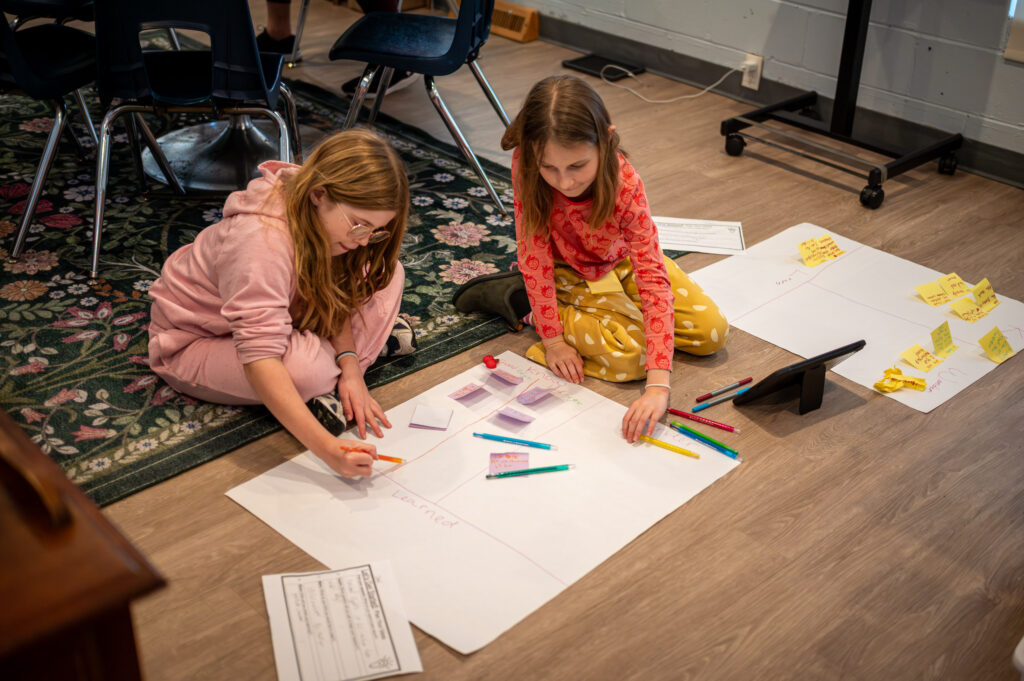
Project-Based Learning at AMPed Academy
At AMPed, students spend their days working on problems worth solving. They investigate, build, debate, revise, and share their findings with a real audience. This is the core of our academic program, from kindergarten through ninth grade.
What is project-based learning?
Project-based learning is a teaching approach where students gain knowledge and skills by working over an extended period to investigate a meaningful, open-ended question. Every project begins with a driving question — something genuine enough that students actually want to find the answer.
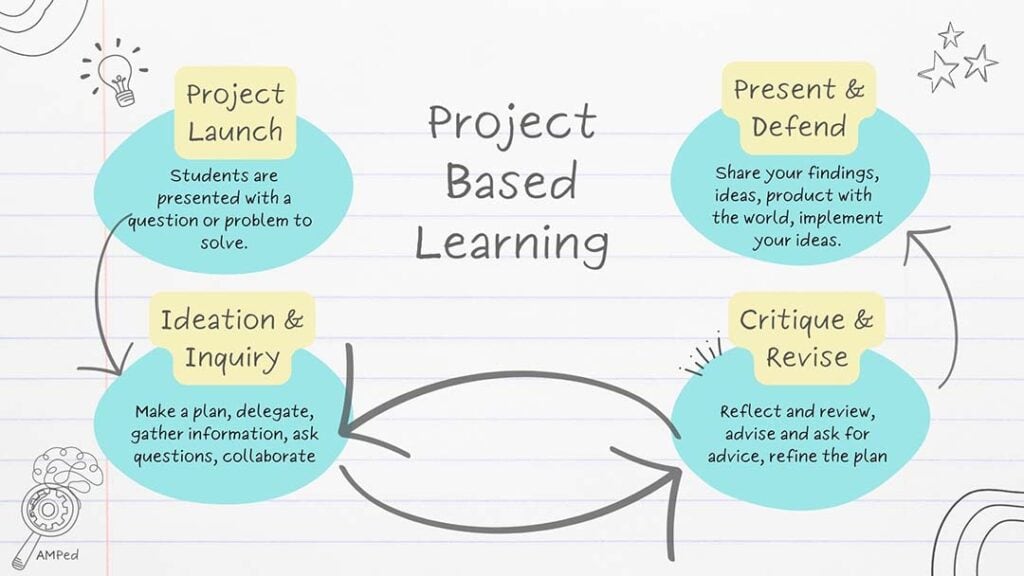
From there, students plan their approach, gather information, collaborate with peers, build something, get feedback, revise their work, and ultimately present their findings to a real audience. The process mirrors how meaningful work happens in the world, and that’s deliberate.
The four phases of every AMPed project
Each project moves through a deliberate cycle that builds academic skills alongside habits of mind.
What students actually develop
When a student spends weeks investigating a real question, presenting to a real audience, and defending their thinking, they build capabilities that follow them well beyond the project itself.
Academic depth
Students retain what they’ve genuinely investigated and applied — knowledge they actually had to use.
Collaboration Skills
Students learn to plan together, divide work, disagree constructively, and build something as a team.
Communication
Presenting and defending real work to real audiences builds a kind of confidence that rehearsed speeches don’t.
Projects our students have completed
Each of these was a full unit of study — science, social studies, research, writing, and public speaking woven together around a single driving question.
Becoming Informed Voters
Students researched the 2024 Michigan ballot, built out candidate platforms with supporting documentation, and staged a mock senate debate — defending positions in front of peers and community members.
Exploring New Worlds
Should humanity find a new home in space? Students studied orbital mechanics, Earth’s habitability conditions, and the physics of gravity — then created time capsules explaining what future generations would need to survive elsewhere.
Dinosaur Discovery
Students became paleontologists, studied extinction through the lens of climate change, and built a public fossil exhibit to raise awareness about animals at risk today.
Questions families ask about PBL
How do you make sure students are actually learning the academics?
Every project at AMPed is built around academic content — reading, writing, math, science, social studies — woven into the work rather than taught in isolation. Teachers know exactly what skills and concepts each project is developing, and student progress is tracked through portfolios, teacher observation, and regular skill checks alongside the project work. Families tell us their kids are learning more, going deeper, and actually remembering what they studied. That’s the goal.
How are students assessed?
Students demonstrate mastery through their project work, portfolios, presentations, and exhibitions. Teachers use rubrics tied to academic skills and the qualities we’re developing in every student — curiosity, collaboration, communication, resilience. Families receive narrative progress reports that reflect the whole child, including where they’ve grown and what they’re working toward next.
Is PBL a good fit for students who struggled in traditional school?
Many of our families come to us because something about traditional school wasn’t working for their child — whether that was the pace, the format, the social environment, or simply that their kid needed to see why the learning mattered. PBL tends to unlock engagement for those students because the work is meaningful and the path to demonstrating what they know is flexible. That said, AMPed is a strong academic program, and we hold high expectations for every student here.
My child likes structure. Will PBL work for them?
PBL at AMPed is structured. Every project has clear phases, checkpoints, and teacher guidance woven throughout. Direct instruction happens when students need it, in service of something they’re actively working toward. Students who thrive with structure often do very well here because the framework is consistent — they always know where the project is headed and what’s expected along the way.
Will my child be prepared for a rigorous high school program?
AMPed students leave with strong academic skills and something harder to teach: the ability to manage a long project, work through ambiguity, take feedback without shutting down, and present ideas with confidence. Those habits tend to be exactly what rigorous high school programs are looking for — and what most students arrive without, regardless of their GPA.