
Upper Elementary
Where Independence, Intellectual Curiosity, and Deeper Thinking Take Shape
Upper Elementary at AMPed is a period of meaningful academic growth. Students move beyond foundational skills and begin applying their knowledge with greater independence, curiosity, and intellectual depth. Reading, writing, and mathematical thinking expand into more complex work as students ask stronger questions, analyze ideas, and take greater ownership of their learning.
Learning experiences continue to integrate literacy, mathematics, science, and social studies, but expectations rise. Students plan projects, engage in deeper research, collaborate with peers, and present their thinking with increasing clarity and confidence.
Cohort Placement at AMPed
Students are placed into learning cohorts based on readiness, independence, and social development—not strictly by age. This allows us to maintain academic rigor while honoring each child’s pace of growth.
Building Independence and Academic Depth
Upper Elementary marks an important shift. Students move from learning foundational skills to using those skills to explore ideas, investigate questions, and solve problems. As reading becomes a tool for learning, the world opens up in new and exciting ways.
At AMPed, this cohort balances increasing academic expectations with the developmental reality that students still need movement, play, and hands-on engagement. Learning is rigorous, active, and deeply human.
How Learning Works in Upper Elementary
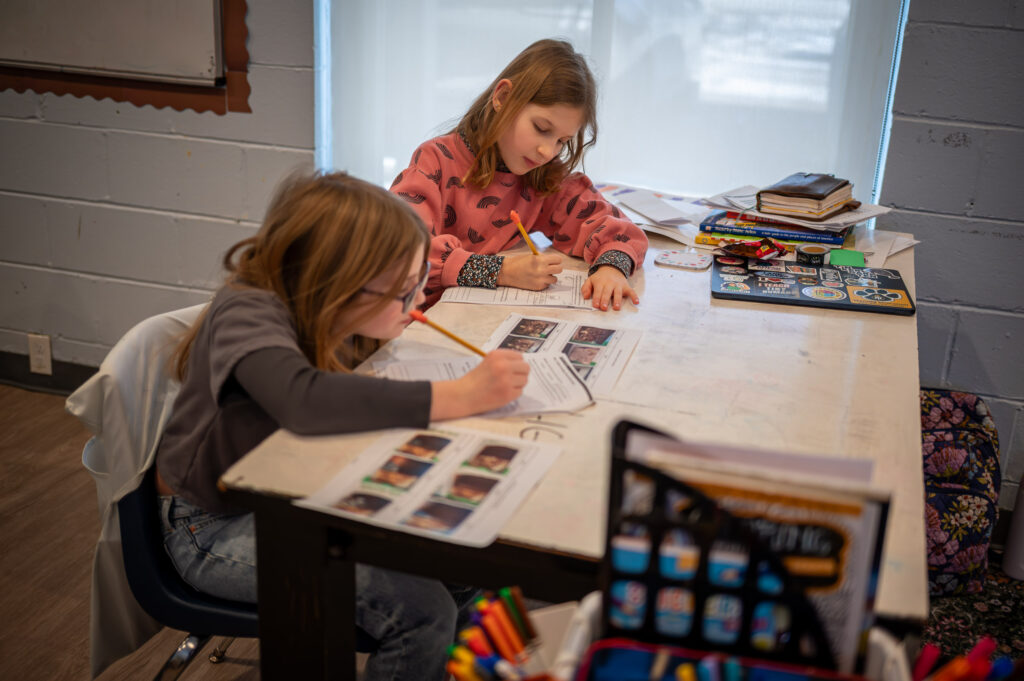
Learning is organized around interdisciplinary projects that may integrate reading, writing, mathematics, science, and social studies. Faculty design experiences that require students to think critically, manage longer-term work, and take increasing ownership of their learning.
Students are explicitly taught how to:
- Plan and manage multi-step projects
- Identify what they already know and what they need to learn
- Apply academic skills in real contexts
- Reflect on feedback and revise their work
Teachers remain closely involved—providing structure, guidance, and support as students grow more independent.
Academic Focus Areas
- Reading & Writing: Students engage with a range of texts and write for real purposes, including explanation, research, and reflection.
- Mathematics: Math is applied to authentic problems, emphasizing reasoning and conceptual understanding as they move into more abstract concepts.
- Science & Social Studies: Students investigate real-world topics, develop questions, and use evidence to support their thinking.
- Creative Expression & Design: Art, design, and creative problem solving are integrated across projects.
Demonstrating Learning
Learning is demonstrated through projects, conversations, visual models, early portfolios, and exhibitions that celebrate progress and effort. By the end of Lower Elementary, learners have strong foundations, a positive sense of self, and a genuine love of learning.